Introduction
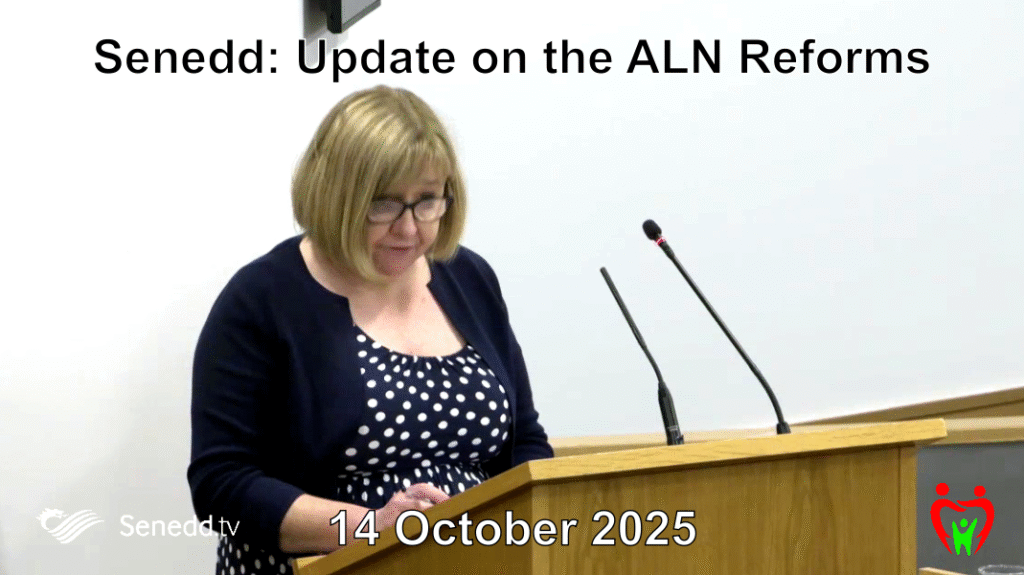
A Senedd Plenary session on 14 October included a statement from Lynne Neagle, Cabinet Secretary for Education, on the Additional Learning Needs [ALN] reforms. Transcript / Watch This was timed to coincide with Neagle’s publication of the ALN and Education Tribunal Legislative Review findings and the parent and carer survey that formed part of the ALNET evaluation (linked below).
In response to a subsequent question about home education, Neagle reiterated a familiar objective of hers that “we want our children to be in school” and went on to draw some inferences from a remarkably small and selective sample of home educating parents. This was in the context of responding to various points raised by Heledd Fychan MS (Plaid Cymru) relating to the recently published “Evaluation of the Additional Learning Needs system: survey of parents and carers.”
Fychan asked: (para. 322)
“85 per cent of people who’ve electively decided to home educate their children have said that the lack of support was one of the reasons, and half of them would like their child to return to school. So, how do we support those families that want to get those children back to school to ensure that they are able to do so?”
Unrepresentative data?
The small numbers on which these percentages are based, however, should signal the need for exercising caution in interpreting them. There are over 7,000 home educated children in Wales, but there were only 33 responses to this survey by home educators, with 28 out of those 33 indicating that their decision to home educate was “influenced by any concern that the schooling offered by the local authority would not meet their child’s learning needs.” These 28 respondents reflect just 0.39% of the known home educating population of Wales, using the Government’s own figures.
Furthermore, it is unclear how EHE parents were selected to take part in this survey. The survey cites schools as being the main source of distribution. Was it only those who had had some form of engagement with the ALN system within schools that were invited to take part in this survey, or who were more likely to have encountered it? Despite “stakeholder networks” being cited as a mode of distribution of this survey, no national, regional or local home education groups report being made aware of it by the Government. This despite previous attempts at engagement by various groups who are, self-evidently, known to the relevant department.
Focusing on families who have had contact with the ALN system may well be a relevant approach for a report on the ALN system within schools. However, such an approach will be unlikely to produce information that is representative of the wider population of home educators. Yet from this exchange, one could readily be left with the impression that it is considered to do just that.
Furthermore, the comments in Plenary do not reflect the lived experience of home educators, as documented in up-to-date research showing how reasons for choosing home education so often change with time and experience. This frequently includes a change from those initial “push” or “negative” factors causing families to feel “forced” to home educate at first, to the self-same families often finding their reasons for continuing with home education to have become “positive” or “pull” factors. This change can often occur as families discover how alternative approaches work, and when they see the benefits and positive outcomes for the children.
The report being discussed states that 50% of the 28 EHE respondents who cited lack of provision in school as a factor in their deregistration would like their children to return to school. It also states that over half of the EHE respondents have been home educating for less than 12 months. The data to demonstrate how many of those wishing for a return to school fall into that newly deregistered category is not available. This is significant, as home education is not necessarily a quick-fix approach. It takes time and patience for each family to find their way to the most beneficial learning approach for each child. We are often so used to school-based approaches to education that it can take families some time to understand and appreciate the benefits of other pedagogies. Likewise, it can take time, care and patience for children to heal from the often profoundly damaging psychological impacts of negative school experiences.
Home education not just a stopgap
These Plenary exchanges fail to appreciate how home education is not simply a second-best alternative if and when school-based provision is suboptimal. Rather, it is often a better approach, providing children with that individualised, non-pressured, relational, child-centred nurturing that can allow all children to thrive, especially those with ALNs.
It is interesting to consider whether the Government’s ALN reforms have impacted rates of EHE in Wales. Ceredigion was cited as an example of good practice. Both the lack of provision of “special schools” and the fact that children are not sent out of county for specialist education elsewhere were commended. Yet Ceredigion has the highest rate of EHE in Wales, at twice the Welsh national average, so one can only wonder whether such policies as lack of separate specialist provision actually bear any relation to this increased rate of EHE among families within that county.
Note too that the survey did not ask EHE families whether they wanted their child to have a LA-maintained Individual Development Plan or not. This is relevant as the ALN Act does not give EHE families the option of whether or not to have an IDP, but puts the decision-making process for this purely into the hands of the LA – an element of the legislation that is of particular concern.
It is not unknown for EHE families to report that such mandatory LA-maintained IDPs are unhelpful and an extra source of stress or unproductive bureaucracy, and that they would prefer them to cease. This is also a matter to note for any families who would like an IDP but have not been given one. The very small numbers in this survey certainly indicate little satisfaction with the ALN system. Ideally it should be the family who guide the process of whether or not having an IDP is useful, but this survey does not appear to address the issues of consent or family preference at all.
On the same topic, there is a potential contradiction in the Welsh government’s approach here. If a child were to echo the parent’s wish for them to return to school, then the presumption would seem to be that everything possible should be done to facilitate this. However, when children express the wish not to have to attend school, would the school and the government be so keen to enable each such child to be home educated?
Obvious to whom?
The exchange reveals the mindset of the Welsh Government in relation to home education, with Neagle’s response raising a number of concerns:
“And on the elective home education, I absolutely recognise what you said there, because I know that there are families who have withdrawn their children for that reason.
Obviously, we want our children to be in school.
As part of this work, we’re doing specific work around three groups of children: home-educated children, children who are educated other than at school, and also care-experienced children. There is a mechanism for home-educated children to get support from the local authority, and I quite often write back to Members to advise them of that, but I recognise that if families feel their needs aren’t being met, that’s quite a big hurdle to overcome”
Despite home education being of equal worth and weight in the eyes of the law, the Cabinet Secretary for Education in Wales declared to the Senedd that “Obviously, we want our children to be in school…”
Why does this statement ring alarm bells for many home educating parents?
- Is it the “obviously“? – the presumption that it’s a foregone conclusion that all would or should be of the same mindset as the minister in question?
- Is it the “our children“? – as if children belong to the government rather than in families, as if fathers and mothers co-parent with the state?
- Is it the repeated desire of the Minister to see “all children in school” – the presumption that school is the best place for children?
The Minister is Cabinet Secretary for Education, not Cabinet Secretary for Schools. Many people would challenge the presumption that public servants and politicians have the right to decide that school is the best place for all children.
Exactly what is the “specific work” in relation to home-educated children, which the Minister claims is being done, or is about to be done? Has the Minister personally engaged with actual home educated families in preparation for any such “work”? Will this “work” show respect for and trust in home educating families? Or will it demonstrate a political belief that parents require oversight to raise their own children? Concerned lawyers and non-home educators have pointed out of late that this “specific work” will seek to treat law-abiding parents as if they are “doing something wrong.”
It is time the Welsh Government engaged meaningfully with concerned home educating parents to answer some of these issues, and we would welcome the opportunity to help them reach a wider spectrum of home educators.
Whether the government continues its policy of non-engagement with a wide spectrum of home educators or not, it is certainly unhelpful to extrapolate a survey that was designed to look at the ALN system as though it applied to home education in general.

NEWS
UPDATES
To keep up to date with information concerning political discussion about home education in Wales, join our mailing list.
or you can

